
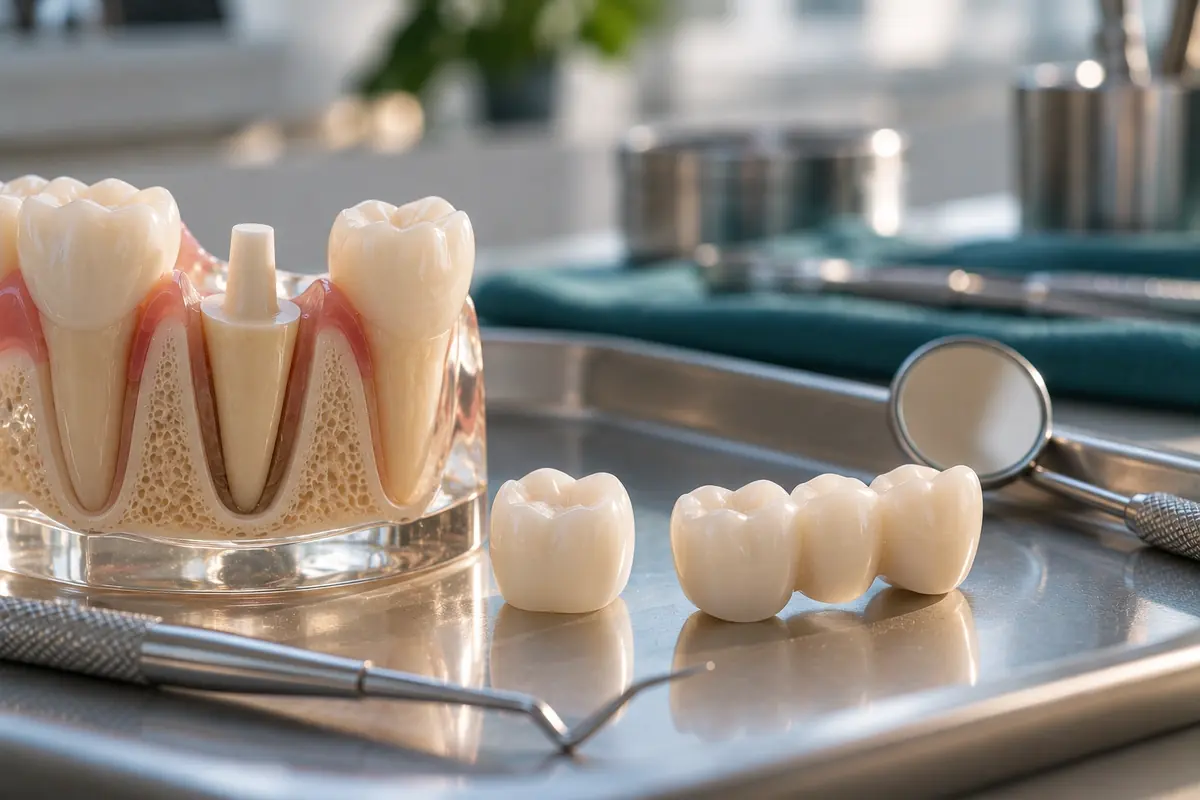
A crown covers a whole tooth that has been reshaped, and a bridge replaces a missing tooth by attaching a false tooth to the teeth on either side. Both can be the right treatment, and both mean cutting down natural teeth, which cannot be undone.
Ask why this tooth, why this type, and what the less invasive options are, and get the answers in writing before any tooth is cut.
What patients are quoted
We are collecting anonymous quotes for this treatment. Figures appear here once at least ten quotes are in.
Share the price you were quoted. It is multiple choice only and asks for no personal details. How the figures are calculated.
At a glance
- Can it be undone?
- No. Natural teeth are cut down.
- How long?
- Usually two visits about two weeks apart.
- Reported lifespan
- Crown around 8 to 10 years. About 80% of conventional bridges last 10 years or more (Leeds).
- Ask first
- Why this tooth, and is there a less invasive option?
Crown timeline
- Visit 1Tooth reshaped, impression taken, temporary crown fitted
- LaboratoryAbout two weeks
- Visit 2Permanent crown fitted and bite checked
Source: Leeds Teaching Hospitals NHS Trust.
Crowns
A crown is a restoration that fits over a tooth the dentist has reshaped. Leeds Teaching Hospitals says it can rebuild a tooth that is badly broken or weakened by decay or a large filling, and notes that a crown involves removal of some tooth structure.
- When it is usually needed: a tooth weakened by a large filling or cavity, large discoloured fillings in front teeth, tooth wear, or a root-filled tooth with a large filling.
- Materials: porcelain fused to metal (strong, good appearance), metal alloys (strong, used where it is not visible) and all-ceramic or porcelain (where it will be seen and the bite is not heavy).
- Visits: usually two. At the first the tooth is reshaped, an impression is taken for the laboratory and a temporary crown is fitted. The permanent crown is fitted about two weeks later.
- Lifespan: with proper care a crown or veneer should normally last around 8–10 years (Leeds). It is not a lifetime restoration.
- Less suitable when: oral hygiene is poor, decay is frequent, gum disease is active, or you clench or grind your teeth.
Alternatives to ask about: a white (bonded) filling to rebuild the tooth, or, for a front tooth where the bite is not heavy, a porcelain veneer, which removes less tooth than a crown.
Bridges
A fixed bridge replaces one or more missing teeth with a false tooth fixed to the tooth or teeth on either side of the gap. Leeds Teaching Hospitals describes two main types:
| Type | What it involves | What the NHS leaflet says |
|---|---|---|
| Conventional bridge | The neighbouring teeth are reduced to pegs and crowned to carry the false tooth. | Substantial drilling. The supporting tooth's nerve can be irreversibly damaged in a small percentage of cases (up to 10–15%), which may need root canal treatment. About 80% last 10 years or longer with relatively minor complications. |
| Adhesive bridge (resin-retained, “Maryland”) | A metal wing is bonded to the back of the neighbouring tooth, with little or no drilling. | Most common problem is that it comes unstuck, usually fixed by re-sticking. About 80% last 5 years or longer. The supporting tooth may look slightly greyer. |
Other risks: decay at the edge of the bridge and gum disease in the supporting teeth. Clean carefully under the false tooth along the gum line, as your dentist or hygienist will show you.
Alternatives to ask about: leaving the gap (a small risk that neighbouring teeth drift), a removable denture (usually when several teeth are missing) or a dental implant (see the implant page).
What to check before your teeth are cut
- The reason for each crown. Is the tooth damaged, heavily filled or root-filled, or is the crown for appearance only? A crown on a healthy tooth is a different decision.
- The type of bridge and how many teeth are cut. A bridge replacing one tooth that crowns two healthy neighbours is a bigger step than it looks. Ask why an implant or adhesive bridge is not suggested.
- The material. Ask for the name of the material and the laboratory, in writing.
- The fit and the bite. You should be able to try a temporary and report problems. A poorly fitting crown can cause pain, decay or bite problems.
- Maintenance. Ask who will check the margins, replace the crown when it wears and treat any problems. Plan for that cost.
Questions to ask before you agree
Tap a question to copy it, then paste it into a message or an email.
Crown and bridge checklist
Tick items off as you complete them. Your ticks stay in this browser only.
Before you book in Türkiye
The same checks apply whichever treatment you choose. Each links to a full guide.
- Check the authorisation. Make sure the clinic, and any agency, holds a Ministry of Health authorisation for international patients. How to verify it
- Get the plan in writing, tooth by tooth. It should name the treatment, materials and brands for each tooth, and the full price. Questions to ask
- Read the guarantee before you pay. Find out what it covers, for how long and who pays for travel if something needs fixing. Guarantees
- Know what you are agreeing to. You have the right to clear information about risks and alternatives before you consent. Informed consent
- Take your records home. Ask for X-rays, scans and a written summary, including implant brands and sizes. Dental records
- Plan aftercare before you go. Find a dentist at home who will see you for checks and problems. Follow-up care
- Know where to turn if things go wrong. Complaint routes
Frequently asked questions
How long does a crown last?
A Leeds Teaching Hospitals leaflet says around 8–10 years with good care. Individual results vary.
Is a bridge better than an implant?
Neither is always better. A bridge needs neighbouring teeth to be cut (conventional type) but no surgery. An implant needs surgery but leaves neighbours alone. See the implant page.
Will a crowned tooth need a root canal?
Sometimes. Cutting a tooth can damage its nerve. The leaflet figures given for bridge supports (up to 10–15%) are for that situation. Ask what the plan would be.
Can crowns be done in a few days?
Often yes in principle, since laboratories can be quick, but a short schedule gives less time to check the fit. Ask for the trial period and the follow-up plan.